
Modern scientific culture has been built, in large part, on the expansion of visibility. From the invention of the microscope to contemporary genomic sequencing, the ability to render the unseen visible has been treated as both a methodological breakthrough and a philosophical orientation. To know something, within this paradigm, is often to observe it, isolate it, measure it, and render it real through instruments that extend the human senses.
This has produced extraordinary insight into the microbial world. Organisms once entirely unknown have been classified, sequenced, and mapped; biochemical processes that structure life have been made observable; causal relationships between microbes and disease have been established with increasing precision. The unseen has been progressively incorporated into the domain of the known. This expansion of visibility has also shaped what is recognised as knowledge. As a result, phenomena that cannot be easily observed, isolated or quantified have often been pushed to the margins or forced into frameworks that fit existing scientific models. The consequence is a worldview in which visibility becomes a measure of reality itself, and where things that cannot be directly seen are often treated as speculative, uncertain, or even unreal…
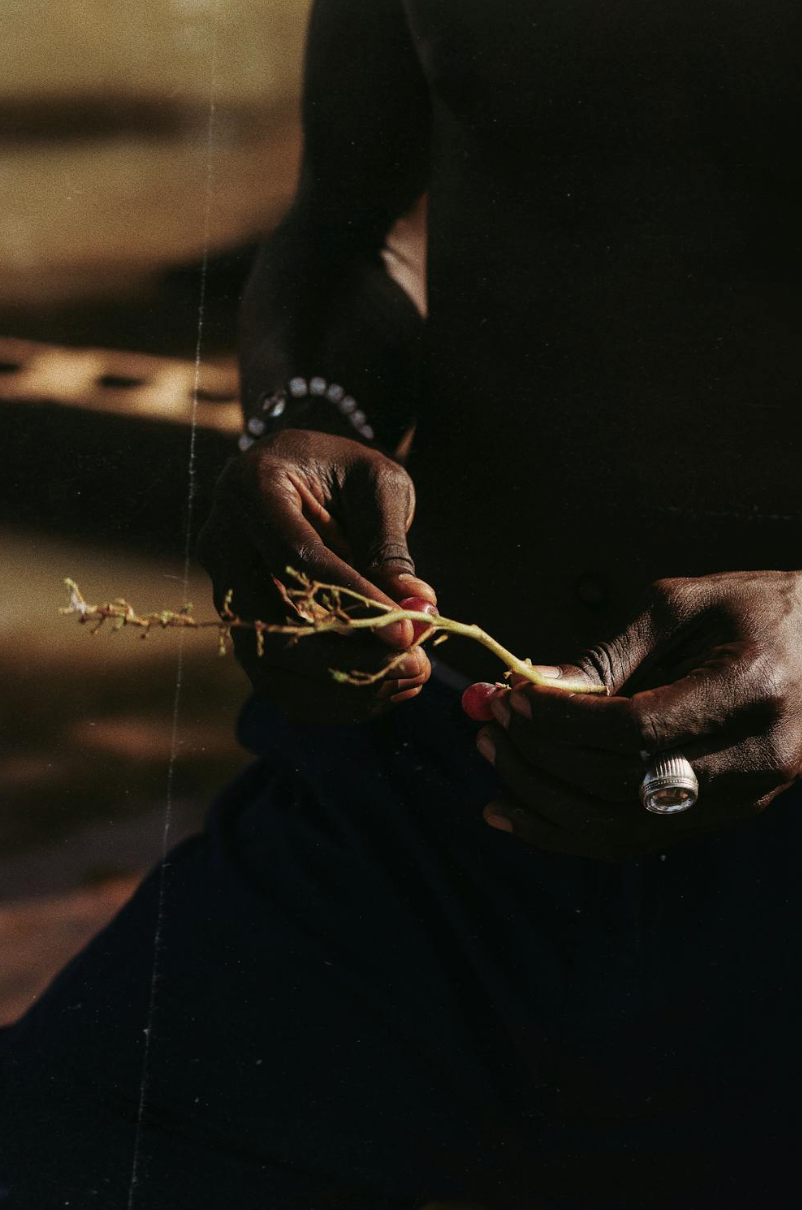
photographed by Abdullahi Santuraki, via Pexels
The microbiome complicates this orientation. While it can be studied through instrumental technologies, it is not legible to our everyday understanding. It is a dynamic system, constantly shifting in composition and function, shaped by context and interaction. Even when rendered visible through sequencing or imaging, it does not resolve into a fixed object of knowledge; the microbiome feels abstract, because it is experienced in that way. Still, long before microbial life was observable through scientific instruments, many knowledge systems operated with an understanding that what cannot be seen is nevertheless active, consequential, and relational. These systems did not require visual confirmation to recognise the presence of forces, entities, or dynamics that shape health, environment, and social life.
Across a range of indigenous and traditional knowledge frameworks, the unseen is regarded as a dimension of reality that must be engaged with through relational awareness rather than direct observation. Anthropological work has consistently documented how such systems articulate complex understandings of environment and health through concepts that do not rely on visual verification alone. For example, within many Southern African cosmologies, health is understood as a state of relational alignment between the individual, the community, the environment, and ancestral presence. Illness may be understood as a disturbance in these relationships, requiring forms of care that address both material and relational dimensions.
What distinguishes these knowledge systems is that reality is understood as relational and continually in formation. Rather than isolating phenomena into units, they understand entities as constituted through their relationships with other entities, environments, and forces. This aligns, in a striking way, with contemporary systems thinking and ecological science, in which outcomes are increasingly understood as emergent properties of interactions within complex systems. The microbiome, for example, cannot be meaningfully understood as a collection of individual organisms alone; it must be approached as an ecological network shaped by host biological and environmental dynamics.

Ecological activist Vandana Shiva has written extensively on how dominant scientific and agricultural systems have, over time, separated knowledge from the contexts that give it meaning. In her work, she points to the ways in which traditional ecological knowledge, particularly in farming communities, is grounded in an ongoing relationship with land. Soil, for instance, is understood as a living system that must be cared for, observed, and responded to. Similarly, botanist Robin Wall Kimmerer describes knowledge as something that arises through reciprocity. Drawing on both her training as a scientist and her grounding in Indigenous knowledge, she articulates a mode of understanding in which humans are participants in the systems they study; even and especially scientists! In this framing, attention, and gratitude are our responsibility. To know something is also to be in relationship with it, and to be accountable to that relationship over time. What becomes clear, across these different approaches, is that life is constituted through relationships, and the challenge is to hold open a space in which multiple ways of knowing can coexist, each maintaining its integrity while contributing to a more complete understanding of the systems that we are part of.
Through our work at MFI, we are interested in situating the microbiome within a broader field of understanding; one that extends beyond science. We see this as an expansion of our foundational scientific understanding of what the microbiome is. We believe that by placing microbial life within cultural, ethical and collective context, that we can create shared reference point for how we might inhabit the future with greater awareness, reciprocity and care. In borrowing wisdom from Indigenous knowledge systems from time immemorial, that we need not 'see' the microbiome to recognise and celebrate it as a living presence that sustains us.
When we say that MFI is a cultural platform, and that we are embarking on cultural work through the lens of the microbiome, we mean creating the conditions for these conversations to take place. We’re exploring how microbial life intersects with design, art, philosophy, ecology, health, food systems, architecture, education and everyday practice, and our aim is to test how new scientific understandings can inform culture; influencing the stories we tell, the values we hold, and the ways we relate to one another and the living systems that make life possible. The microbiome is a cultural invitation to reconsider what it means to be human within a deeply interconnected world; and MFI is your portal into this invitation.
